

 Current position > Product detail
『Glycol Flow Meter Sizing: Multi-Variable BTU Sensors for Commercial HVAC Chilled Water Loops』Related information(flow rotameter|digital flow meter|balo meter|hydraulic flow meter|volumetric meter|positive displacement meter|pitot tube flow meter|displacement meter|cfm meter|variable area flow meter|inline flow meter|differential pressure flow meter|calibrated flow meter|velocity meter|paddle wheel flow meter|oval gear flow meter|anemometer hvac|multiphase flow meter|doppler flow meter|thorpe tube flowmeter|heat flow meter)
Glycol Flow Meter Sizing: Multi-Variable BTU Sensors for Commercial HVAC Chilled Water Loops
Quick Answer
For a commercial HVAC chilled water loop with 30 percent propylene glycol, size the flow meter for 1.8 to 2.4 m/s at normal cooling load. Select a full-bore electromagnetic flow meter with PT100 temperature inputs and a 4 to 20 mA HART output for BTU calculation. Silver Instruments supplies electromagnetic flow meters for glycol service from DN15 to DN300 with accuracy of 0.5 percent of rate. Send us your glycol percentage, pipe size (DN), flow range (m³/h), temperature (°C), and pressure (bar) for a fixed quote.
Glycol Flow Meter Sizing Starts With Fluid Properties
Glycol changes viscosity and thermal conductivity. A 30 percent propylene glycol mix at 5 °C has viscosity around 4.5 cP. Water at the same temperature has 1.5 cP. This matters for velocity profile and minimum flow range. Most engineers skip this part and then wonder why the meter reads zero at low loads. In practice, you need the minimum flow velocity above 0.3 m/s for an electromagnetic flow meter. Normal flow velocity should sit near 1.5 to 2.5 m/s. The maximum flow velocity can reach 10 m/s for short periods. For glycol above 40 percent, specify PTFE liner and 316L electrodes.
Multi-Variable BTU Sensors Reduce Wiring and Integration Time
A BTU loop needs flow, supply temperature, and return temperature. The transmitter uses mass flow times specific heat times temperature difference. With a multi-variable BTU sensor you wire one instrument instead of three. Silver Instruments can supply the electromagnetic flow meter with two PT100 inputs. The transmitter reads supply and return temperature directly. It outputs energy rate in kW or BTU per hour over 4 to 20 mA HART. This setup works well for chilled water and glycol loops in commercial buildings across Southeast Asia and the Middle East.
Recommended Meter Types for Glycol Service
Electromagnetic flow meters are the first choice for glycol loops from DN15 to DN300. The Silver Instruments SIL-EMF series uses a full-bore design with hard rubber or PTFE liner. It has no moving parts and no pressure drop. Use the full-bore model when conductivity is above 20 µS/cm. A 30 percent glycol water mix usually stays above this level. But for larger pipes above DN300, clamp-on ultrasonic flow meters can reduce installation cost. Thermal mass flow meters do not suit liquid glycol because heat transfer calibration shifts with fluid composition. Oval gear flow meters can work for small chemical dosing lines but can clog in HVAC loops with iron oxide. We have seen this on customer sites many times.
Sizing Example for a 200 TR Chilled Water Plant
Assume a 200 ton refrigeration plant in Malaysia. The chilled water loop uses 25 percent propylene glycol. Design flow is 110 m³/h. Pipe size is DN150. The minimum stable flow at 20 percent load is 22 m³/h. For this case, a DN150 electromagnetic flow meter covers 19 to 160 m³/h. Normal flow at 110 m³/h gives velocity near 1.8 m/s. The meter accuracy is 0.5 percent of rate from 0.3 to 10 m/s. A multi-variable BTU transmitter with two PT100 inputs calculates energy usage for the whole building. The output is 4 to 20
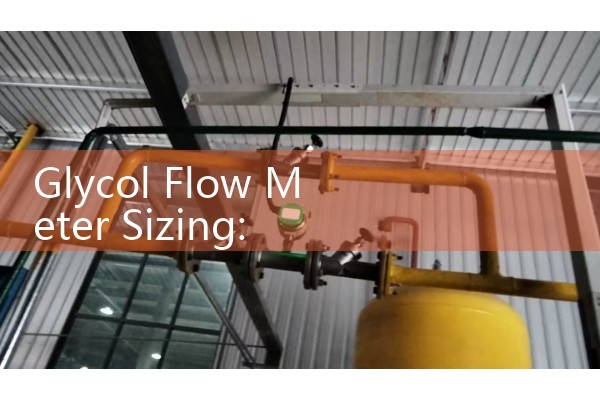
Last year a facility manager in Vietnam asked us to replace an existing turbine meter on a glycol loop. The old meter was oversized. We changed it to a DN100 electromagnetic flow meter and the energy reading became stable at part load.
Installation Notes for Glycol Flow Metering
Mount the electromagnetic flow meter with straight run of 5 DN upstream and 2 DN downstream. Install the meter in the return line if possible. The return line has lower temperature and less thermal stress. Place the supply and return PT100 sensors in thermowells close to the flow meter. Keep the PT100 cable shielded and grounded at one end. Do not install the flow meter at the highest point of the loop. Air bubbles collect there and cause false readings. Because glycol systems can run at 1 to 4 bar, use PN16 flanges as standard. For higher pressure, specify PN40.
Output and Integration for Building Management Systems
Most commercial HVAC jobs need 4 to 20 mA HART, pulse, and Modbus RTU. Silver Instruments supplies transmitters with all three outputs. The BTU result can be read directly in kW or BTU per hour. This avoids a separate PLC calculation. The transmitter stores total energy in MBTU. You can reset it by password or via Modbus. For building management systems from Honeywell, Siemens, or Johnson Controls, the Modbus map is open and documented. The HART signal helps commissioning if the loop has variable speed pumps.
How to Request a Glycol Flow Meter Quote
Send us these six values: glycol type, glycol percentage, pipe size, minimum and maximum flow rate, supply and return temperature, and output required. We will reply with a model, flange rating, liner material, and delivery time. For commercial HVAC jobs in Southeast Asia, Silver Instruments keeps DN50 to DN200 electromagnetic flow meters in stock. Typical delivery is 3 to 5 working days from our Nanjing warehouse. For special wetted materials, delivery is 2 to 3 weeks.
Contact Silver Automation Instruments for fixed price and delivery. Tel: +86-25-68650347. Whatsapp: +86-25-52155837. WeChat: +86 15365082610.
FAQ
1. What flow meter is best for glycol chilled water loops? A full-bore electromagnetic flow meter is best for most loops from DN15 to DN300. It handles glycol viscosity changes and has no moving parts.
2. Can I use the same meter for water and glycol? Yes. Select a conductivity threshold above 20 µS/cm and calibrate the transmitter for the expected glycol percentage. The flow reading does not need liquid density to measure volume flow.
3. How do I size the meter for low load conditions? Check the minimum flow at the lowest cooling demand. Use a full-bore meter to keep velocity above 0.3 m/s at that minimum. Do not oversize the meter. Oversizing is the most common mistake in commercial HVAC.
4. What outputs does a multi-variable BTU sensor provide? A typical unit provides one 4 to 20 mA HART for energy, one 4 to 20 mA for flow, Modbus RTU, and two PT100 inputs.
5. What information do I need for a quote? You need glycol type and percentage, pipe size, flow range, temperatures, pressure rating, and output signal. Send these details to Silver Instruments for a fixed price.